What Is the Difference Between a Baby Grand Piano and a Grand Piano
A piano is a pianoforte, right?
Not exactly. In fact, in that location are several kinds of pianos. For one thing, at that place are digital pianos, and there are acoustic ones. Digital pianos create their sounds electronically, and crave power equally well as speakers or headphones in lodge to be heard. Well-nigh digital pianos, in fact, play dorsum samples — that is, digital recordings — of acoustic pianos. Acoustic pianos, on the other mitt, create their sounds in air, by means of strings existence struck past hammers and a wooden soundboard that serves to dilate the sound and then that information technology can be hands heard, without the benefit of any electronic components, and therefore without the need for electricity, speakers or headphones.
As you might approximate, the acoustic pianoforte came first — in fact, nearly 300 years earlier the digital multifariousness. The first pianos were large and therefore called "m" pianos. But there's a second, smaller variety of acoustic piano too: the upright, invented some fourscore years afterward the grand. It has a lot in mutual with its forebear, only there are some significant differences too. In this article, we'll take a look at both the similarities and differences.
The Grand Piano
Every bit mentioned, grand pianos are the largest type, and frequently the most expensive as well. They offer a wide dynamic range, rich resonance, diverse tonality and responsive touch and for those reasons are more often than not the choice of professional musicians, particularly those playing classical music or jazz.
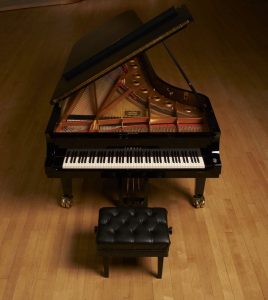
Chiliad pianos vary in size, from "Babe grand" models that can be equally little as 5′ in length, all the way up to "Concert chiliad" models, which can be ix′ or more than. One thing they all take in mutual are massive frames made of cast metal and horizontally mounted soundboards made of thin wood . Dampers lie on top of the strings, next to the hammers, which are besides horizontal, and the hat tin be raised up to further project the sound. All grand pianos provide 88 ivory, forest or ivory-covered wood keys, and include a retractable embrace that contains a canvas music stand and slides over, or folds downwardly on the keys.
Yamaha offers a broad diverseness of chiliad piano models , from the GB1K and GC Serial baby grands to the flagship CF Series concert grands , all providing a perfect blend of craftsmanship and innovation.
The Upright Piano
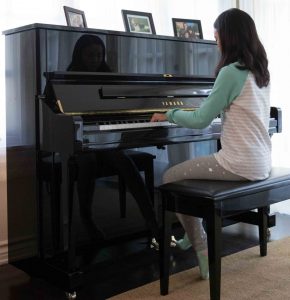
The term "upright piano" is somewhat confusing. It is sometimes used synonymously with "vertical," although technically speaking, an upright is a blazon of vertical piano. Uprights have up much less space and tend to be less expensive than grand pianos. They are a favorite of music students and a staple of schools and conservatories all over the earth, and their compact pattern allows them to be conveniently placed next to a wall or in a corner, making them a popular addition to many living rooms as well.
Similar the grand, upright pianos vary in terms of size, materials and construction, but they all have wooden soundboards that are mounted vertically, with strings that stretch downwards and are struck (and muted) by horizontal hammers and dampers. Upright sizes range from pocket-sized "Spinet" models (popular upward until the mid-twentieth century but rarely made today) of as little as three′ in width, through "Console" and "Studio" models that vary in height but are mostly 5′ wide. They may be smaller than their 1000 cousins, but all upright pianos offer the same 88 keys, usually made of wood or ivory-covered wood.
Yamaha makes a variety of upright pianos , from the compact, entry-level b serial to the U Series — the world's nearly pop upright — to the YUS Series , which shares many of the features of CF Series pianos for a broad range of sonic tonalities more reminiscent of a m piano than a traditional upright.
Differences Between Grand Pianos and Upright Pianos
Every bit we accept seen, two major differences are their size and the mounting of the soundboard and strings (horizontal in grands and vertical in uprights). But these factors have boosted implications. For 1 affair, the larger size of grand pianos means that they have longer strings and larger soundboards, which impart a dissimilar tonality than exercise uprights. This also results in grand pianos having a greater dynamic range (that is, the departure between the softest sounds and the loudest sounds information technology tin produce) than uprights. In improver, 1000 pianos emit sound from in a higher place, while upright pianos emit audio from the back end, which is usually placed confronting a wall. For those reasons, grand pianos can be much louder than uprights.
Another significant difference between the two is their "action" — the mechanism that causes hammers to strike the strings when a key is pressed — which is why they oft feel so different to play. Because the strings are mounted horizontally in grand pianos, the hammers return to their rest position due to the forcefulness of gravity, nether their own weight. In improver, m pianos use a double escapement machinery that allows keys to exist played rapidly in succession, without get-go letting the key return all the fashion to its starting position. In upright pianos, where the strings are mounted vertically, the hammers rely on springs to render to the at-residual position. As a result, key repetition (i.e., when a player repeats notes quickly, such every bit when playing trills) is much smoother and faster in grand pianos than information technology is in upright pianos — to a maximum of roughly 15 times per 2d in grands, versus vii times per second in uprights.
Finally, while both grand pianos and upright pianos offer three foot pedals, they have slightly different functions. In a thousand piano, the pedals are:

– Shift pedal (left pedal): Also called the soft pedal or una corda pedal. When depressed, this shifts the entire activity assembly to the right, irresolute not only the volume of the sound, but besides making slight changes to the tone.
– Sostenuto pedal (middle pedal): This keeps the dampers raised and away from the strings of any keys played just before depressing the pedal, making it possible to sustain selected notes.
– Sustain pedal (right pedal): Also called the damper pedal. When depressed, the dampers remain lifted even if the fingers are taken off the keys, thus sustaining all played notes.
In an upright piano, the pedals are:
– Soft pedal (left pedal): When pressed, all the hammers are moved closer to the strings, reducing the book of the sound.
– Muffler pedal (middle pedal): Also called the practice pedal. When pressed, a thin piece of felt is dropped between the hammers and strings, greatly muting the audio.
– Sustain pedal (right pedal): Functions the aforementioned manner every bit in a grand piano—when depressed, the dampers remain lifted even if the fingers are taken off the keys, thus sustaining all played notes.
This posting is excerpted from the Yamaha Instrument Guide . For more information about Yamaha pianos, click here.
crenshawlixed1941.blogspot.com
Source: https://hub.yamaha.com/pianos/p-acoustic/whats-the-difference-between-a-grand-piano-and-an-upright-piano/
0 Response to "What Is the Difference Between a Baby Grand Piano and a Grand Piano"
Post a Comment